Free DOK Wheel and DOK Levels Chart
A printable Webb's Depth of Knowledge reference for K-12 teachers. Verbs and question stems for DOK levels 1 through 4, in one page you can hang above your desk.
Download the DOK Wheel (SVG) · Read the Full Guide
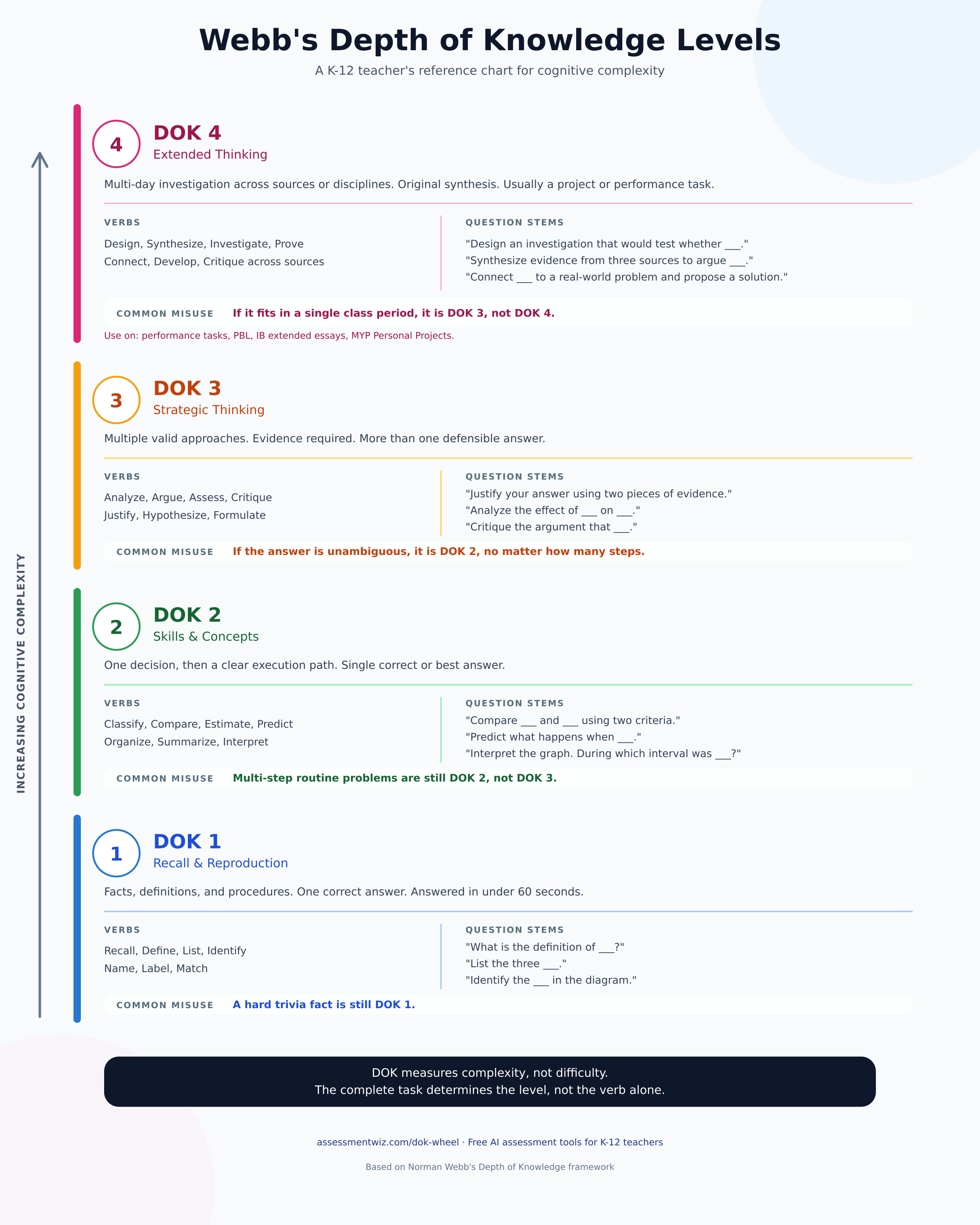
Print-ready • Classroom use permitted • No signup required · Prefer a stacked chart? Download the chart version
What is Webb's Depth of Knowledge?
Webb's Depth of Knowledge is a four-level framework for classifying the cognitive demand of an assessment item. It was developed by Norman Webb in 1997 as a way to align state tests to state standards. Today it is one of the two most-used frameworks in K-12 assessment design, alongside Bloom's Taxonomy.
DOK is not about difficulty. A hard trivia fact is still Level 1 recall. A one-sentence prompt asking students to design an experiment is Level 4 extended thinking. The framework measures the kind of thinking a task requires, not how many students will get it right.
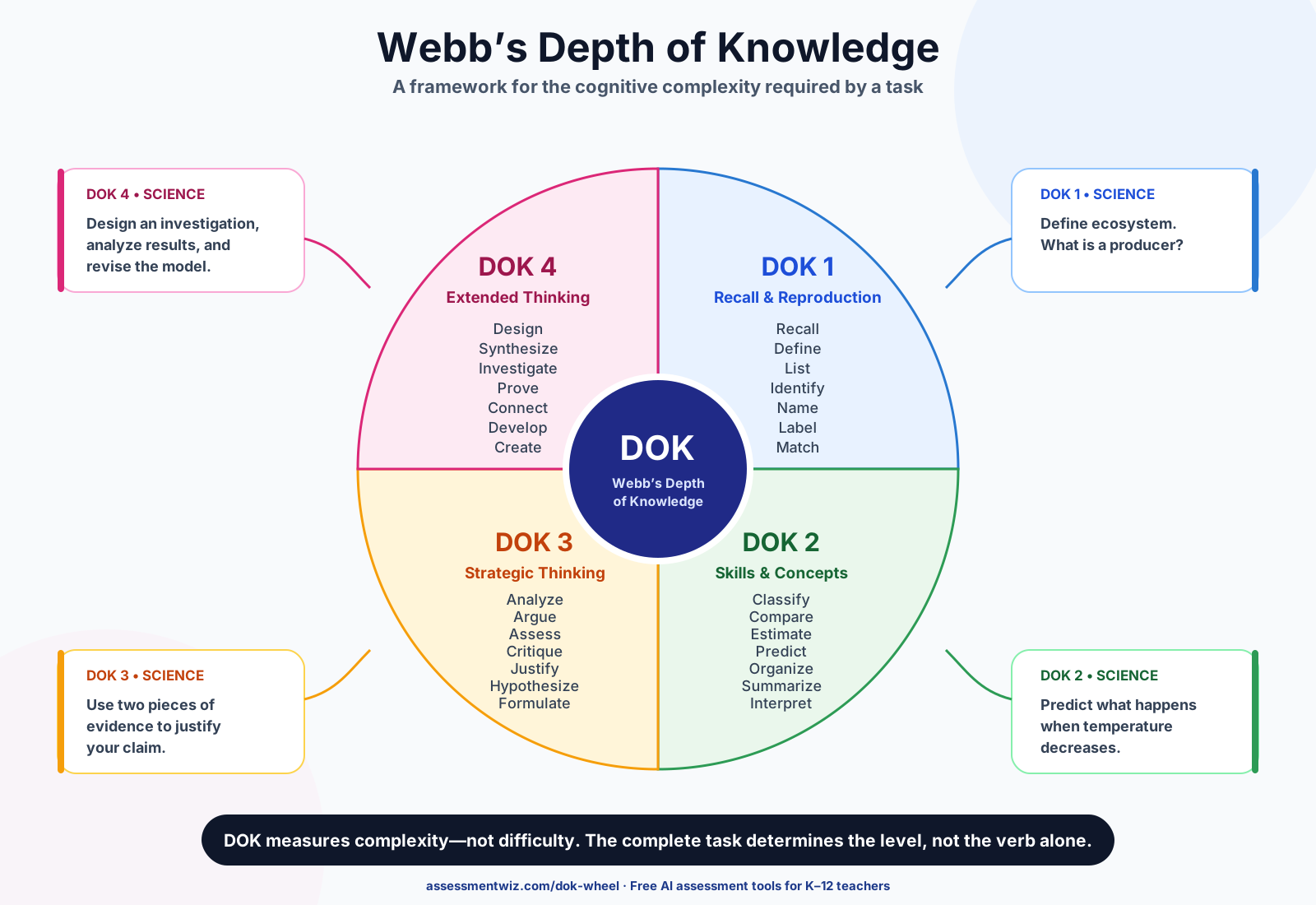
The DOK wheel is a circular reference chart teachers use as a fast lookup. Each level is a wedge, filled with the verbs and question stems that typically operate at that depth. A balanced assessment usually spans multiple levels.
DOK Verbs and Question Stems by Level
Sample verbs and question stems for each depth of knowledge level. Use as a starting point, then adapt to your subject and grade.
Level 1 · Recall & Reproduction
Facts, definitions, procedures. Students remember or reproduce information already given.
Common Verbs: define, identify, list, name, recall, recite, label, match
Sample Question Stems:
- What is the definition of ___?
- Who ___?
- List the steps for ___.
- Identify the ___ in the diagram.
Level 2 · Skill & Concept
Applying a concept or procedure to a familiar situation. Students choose from options they know.
Common Verbs: classify, compare, estimate, organize, predict, summarize, infer, graph
Sample Question Stems:
- Compare ___ and ___ using two criteria.
- Predict what happens if ___.
- Classify the following into ___.
- Summarize the main idea of ___ in one sentence.
Level 3 · Strategic Thinking
Reasoning, planning, and using evidence. More than one right answer, and students must justify.
Common Verbs: analyze, assess, critique, defend, formulate, hypothesize, investigate, justify
Sample Question Stems:
- Justify your solution to ___ using two pieces of evidence.
- Analyze the effect of ___ on ___.
- Formulate a hypothesis for ___.
- Critique the argument that ___.
Level 4 · Extended Thinking
Multi-step investigations across time, using multiple sources or disciplines. Extended tasks and projects.
Common Verbs: design, connect, synthesize, prove, apply concepts, critique across sources
Sample Question Stems:
- Design an investigation that would test whether ___.
- Connect ___ to a real-world problem you care about and propose a solution.
- Synthesize evidence from three sources to argue ___.
- Prove or disprove ___ using original data.
Generate DOK-Balanced Assessments
Skip the manual mapping. These AssessmentWiz tools tag each question with a DOK level automatically.
- Question Stems Poster — Bloom's, DOK, and NGSS SEP stems in a printable classroom reference.
- AI Test Generator — DOK-balanced unit tests with question tagging and answer keys.
- Math Problem Set Generator — DOK-tuned math worksheets with worked solutions.
- DBQ Generator — Level 3 and 4 document-based questions with HIPP scaffolding.
Frequently Asked Questions
What is Webb's Depth of Knowledge?
Webb's Depth of Knowledge (DOK) is a four-level framework developed by researcher Norman Webb in 1997 for classifying the cognitive demand of an assessment item. DOK is not about difficulty; it is about the kind of thinking required. A hard trivia fact is still Level 1 (recall). A short prompt asking students to design an experiment is Level 4 (extended thinking).
How is DOK different from Bloom's Taxonomy?
Bloom's Taxonomy categorizes the cognitive process (remember, understand, apply, analyze, evaluate, create). DOK categorizes the cognitive complexity of the task itself. A task can be "Create" in Bloom's but Level 1 in DOK (creating a list of vocabulary words). A task can be "Apply" in Bloom's but Level 3 in DOK (applying the scientific method to design an original experiment). Most modern assessment writers use both.
What is a DOK wheel?
The DOK wheel is a circular reference chart used by K-12 teachers to write assessment questions at a chosen depth of knowledge level. Each of the four levels is a wedge of the circle, filled with the verbs and question stems that typically operate at that level. It is a fast lookup when writing or evaluating a question.
Is the DOK wheel free to download?
Yes. The chart on this page (SVG format, print-ready) is free to download and use in your classroom. It is licensed for classroom and school use. Attribution is appreciated but not required.
What DOK level should a good assessment cover?
A balanced assessment usually spans multiple DOK levels rather than sitting at one. A common target for a unit test is roughly 20% Level 1, 40% Level 2, 30% Level 3, and 10% Level 4. Formative checks skew toward Levels 1 and 2 (build fluency), summative tests toward Levels 2 and 3, and projects or performance tasks toward Levels 3 and 4.
Are there DOK verbs I should avoid?
Verbs alone do not determine the DOK level of a question. "Explain" can be Level 2 (explain how photosynthesis works using the diagram we studied) or Level 3 (explain why two scientists disagreed about the cause of the Dust Bowl using evidence from both accounts). Judge the whole task, not just the verb. This is the single most common misuse of DOK charts.