About Volcanoes - USGS Volcano Hazards Program
Leveled Reading Passage · Science
Shared by a teacher · Free to use as a template on AssessmentWiz.
Diagram
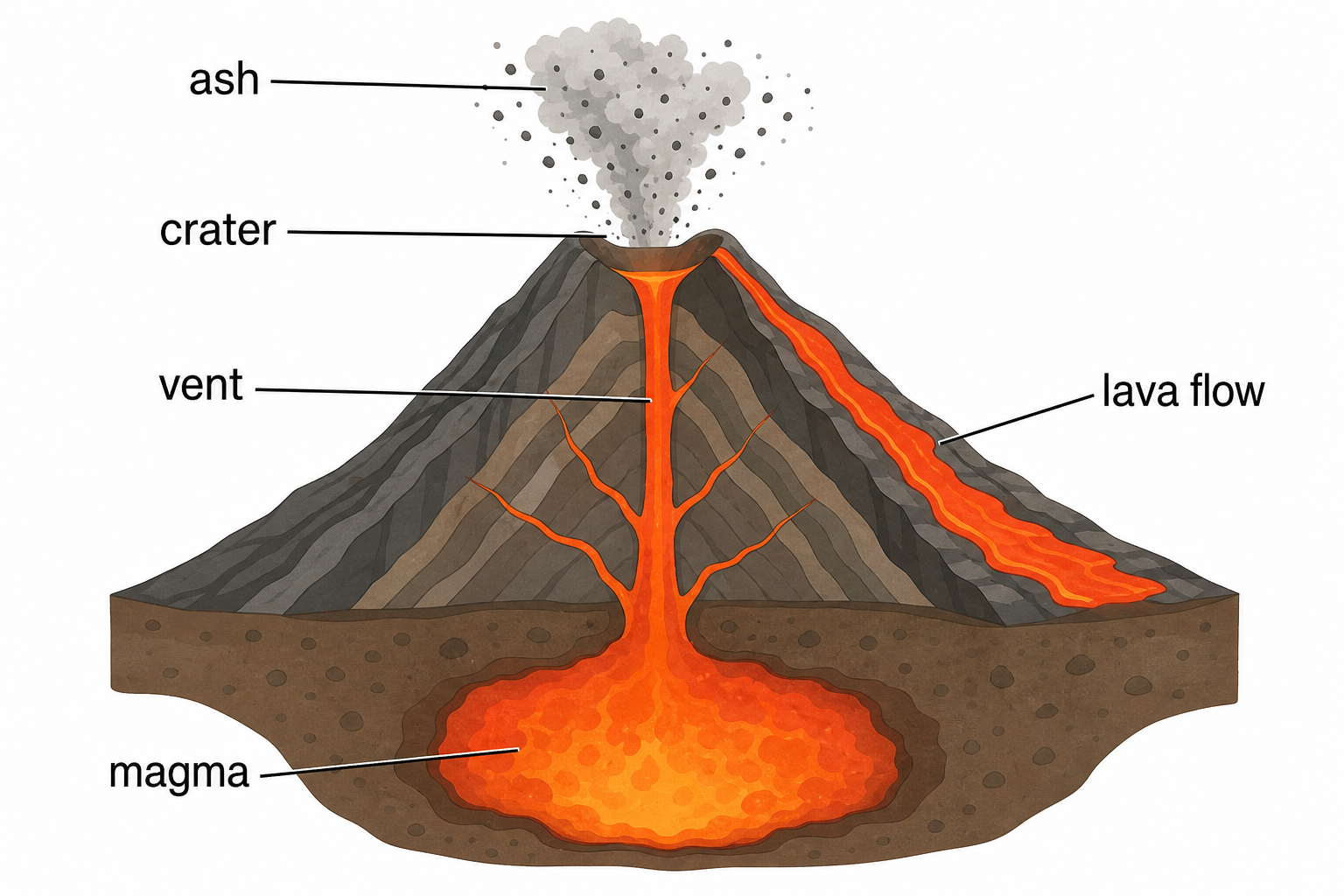
Figure: A cross-section of a volcano showing magma stored underground rising through cracks to the vent, where lava flows out and ash rises into the air.
Type
- text_leveler
Notes
- Website navigation, image captions, and link text were removed as non-passage material; all passage facts, numbers, and proper nouns were kept in order. The source's garbled phrase about buoyancy was smoothed into one clear clause about magma being lighter than surrounding rock, which adds no new fact. The soda-bottle comparison comes from the source and was kept at every level.
Levels
- Word Count: 1167
- Level Label: Grade 8
- Leveled Text: Volcanoes are openings, or vents, where lava, tephra (small rocks), and steam erupt onto the Earth's surface. Volcanic eruptions can last days, months, or even years. What is a volcano? Many mountains form by folding, faulting, uplift, and erosion of the Earth's crust. Volcanic land, however, is built by the slow buildup of erupted lava. The vent may be visible as a small bowl-shaped dip at the summit of a cone-shaped or shield-shaped mountain. Through a series of cracks within and beneath the volcano, the vent connects to one or more linked storage areas of molten or partially molten rock, called magma. This connection to fresh magma allows the volcano to erupt over and over again in the same location. In this way, the volcano grows larger and larger until it is no longer stable. Then pieces of the volcano collapse as rock falls or landslides. How do volcanoes erupt? Molten rock below the Earth's surface that rises in volcanic vents is known as magma, but after it erupts from a volcano it is called lava. Magma is made of molten rock, crystals, and dissolved gas. Imagine an unopened bottle of soda with grains of sand inside. The molten rock is made of the chemicals oxygen, silicon, aluminum, iron, magnesium, calcium, sodium, potassium, titanium, and manganese. As liquid magma cools, it may form crystals of various minerals until it becomes completely solid. It then forms an igneous, or magmatic, rock. Magma starts many tens of miles beneath the ground. It is lighter than the solid rock around it. It is driven toward Earth's surface by buoyancy (the upward push on something lighter than its surroundings) and by pressure from the gas inside it. Magma forces its way upward and may finally break through weak areas in the Earth's crust. If it does, an eruption begins. Magma can erupt in a variety of ways. Sometimes molten rock simply pours from the vent as fluid lava flows. It can also shoot violently into the air as dense clouds of rock shards (tephra) and gas. Larger pieces fall back around the vent, and clouds of tephra may move down the slope of the volcano because of gravity. Ash, which is tiny pieces of tephra the thickness of a strand of hair, may be carried by the wind and fall to the ground many miles away. The smallest ash particles may be blasted miles into the sky. Winds high in the atmosphere can carry them many times around the world before they fall to the ground. How many volcanoes are there? USGS scientists monitor over 160 active and potentially active volcanoes in the United States. Some of these are erupting now, and others could erupt at some point in the future. Most of these volcanoes are in Alaska, a state where eruptions happen almost every year. The rest are located throughout the American West and in Hawaii. Kīlauea volcano on the Island of Hawai‘i is one of the most active volcanoes on Earth. It has been erupting almost nonstop since 1983! There are about 1,350 potentially active volcanoes worldwide, not counting the volcanoes under the oceans. About 500 of these have erupted in the past 100 years. Many of them are located around the Pacific Ocean in what is known as the "Ring of Fire." In the U.S., volcanoes along the west coast and in Alaska (the Aleutian volcanic chain) are part of the Ring of Fire. Yellowstone and the Hawaiian volcanoes, however, form over a "hot spot." What are the main types of volcanoes? Cinder Cone Cinder cones are the simplest type of volcano. They are made of small pieces of solid lava, called cinder, that erupt from a vent. The ground shakes as magma rises from within the Earth. Then a powerful blast throws molten rocks, ash, and gas into the air. The rocks cool quickly in the air and fall to the earth. They break into small pieces of bubbly cinder that pile up around the vent. These pieces build up into a small cinder cone that can be as high as a thousand feet above the surrounding ground. If the wind is blowing during the eruption, cinder is carried downwind before it settles into an oval shape. Eruptions that form cinder cones also feed lava flows that spread outward from the vent. When you climb a cinder cone, you can usually find the bowl-shaped crater that marks the location of the vent. If eruptions of cinder and lava flows happen again and again from the same vent, the overlapping layers can form a composite volcano (stratovolcano). Maps show that thousands of cinder cones exist in western North America and in other volcanic areas of the world. Composite Volcano (Stratovolcano) Some of the Earth's grandest mountains are composite volcanoes, which are sometimes called stratovolcanoes. They are usually tall with steep, even sides. They are made of repeating layers of lava flows, volcanic ash, cinders, blocks, and volcanic bombs. Some composite volcanoes rise over 8,000 feet above their surroundings. However, they reach much higher elevations when measured from the level of the sea (called above sea level). Ojos del Salado in Chile is the tallest composite volcano on Earth, with a summit elevation (height above sea level) of 22,615 feet. The tallest in the U.S. is Mount Rainier in Washington State, with a summit elevation of 14,410 feet. Some of the most famous and beautiful mountains in the world are composite volcanoes. These include Mount Fuji in Japan, Mount Cotopaxi in Ecuador, Mount Shasta in California, Mount Hood in Oregon, and Mount St. Helens in Washington. Shield Volcano Shield volcanoes are built almost entirely of fluid lava flows. Lava pours out of vents in all directions. It comes either from the summit (top) or from two to three rift zones (fractures) that spread out from the summit like spokes on a bicycle wheel. As lava flows overlap one another, they build a broad, gently sloping dome shape. From far away, it looks similar to a warrior's shield. Shield volcanoes build up slowly as thousands of lava flows spread widely over great distances and then cool as thin sheets. On Earth, some of the most massive volcanoes are shield volcanoes. In northern California and Oregon, many shield volcanoes are up to 3 or 4 miles wide and as tall as 1,500 to 2,000 feet. The Hawaiian Islands are made of a chain of shield volcanoes, including Kīlauea and the world's largest active volcano, Mauna Loa. When looking at pictures of volcanoes, you can usually identify them by shape as either a shield volcano or a stratovolcano. Lava Dome A volcano can host many lava domes over a long period of time. So lava domes are technically not a "volcano type" but rather an eruption phenomenon (an event that happens during eruptions). Lava domes are technically lava flows made of lava that is too thick to flow away from the vent. Lava squeezes out of the vent and builds up as a giant pile over and around it. Some domes form pointy spines. Others look like a giant muffin, opening flower petals, or steep-sided stubby flows or tongues. Lava domes often grow within craters or on the sides of large, steep-sided composite volcanoes. Lava domes can be dangerous. They grow mostly by expanding from within. As fresh magma fills the inside, the cooler, harder outer surface shatters and spills hot rock and gases down the mountainside. The circle-shaped Novarupta Dome formed during the 1912 eruption of Katmai Volcano, Alaska. It measures 800 feet across and 200 feet high. This dome was one of the last squirts of lava to come out during a much larger and longer eruption. The eruption at Katmai was the largest and most violent eruption ever to occur within the United States.
Q1. What two forces drive magma toward Earth's surface?
Q2. Why can a single volcano keep growing until parts of it collapse?
Q3. Using the descriptions of shield volcanoes and lava domes, explain how the thickness of lava affects the shape a volcano or dome takes.
Preview shown. The full assessment (all questions, answer key, and teacher notes) loads with the page.
Use this Leveled Reading Passage as a template — customize the topic, grade level, and question types with AssessmentWiz's free AI generator.
Related Assessments
- Unit Test: OpenSciEd 6.2 Thermal Energy (Test · Grade 6 · Science)
- Falling Into Balance: Deciduous Trees and Homeostasis (Lesson Plan · Grade 7 · Science)
- Claim-Evidence-Reasoning (CER) Lesson Plan: The Case of the Classroom Crime (Lesson Plan · Grade 5 · Science)
- Unit Test: OpenSciEd Light and Matter (Test · Grade 6 · Science)
- Radiation and Heat Transfer: Comparing Surface Color and Material Effects on Radiant Heat Absorption (Science Lab · Grade 7 · Science)
- Extracting Iron from Cereal (Science Lab · Grade 7 · Science)